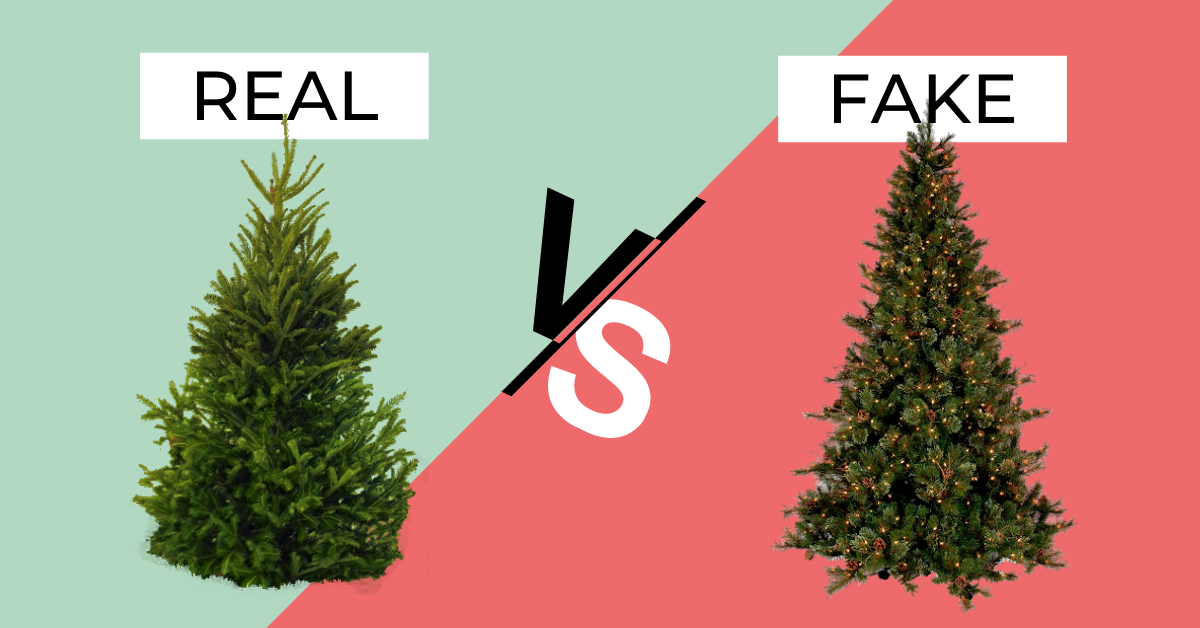
Over 25 million real Christmas trees are sold in the U.S. every year… but fake trees are slowly catching up. When I think of a real Christmas tree, I think of the tradition my family has of going to the Christmas tree farm every Black Friday, the fresh scent of the needles, and the nostalgia of decorating a live tree in my living room. However, there are some setbacks which cause a lot of people to lean towards purchasing a plastic Christmas tree.
For example, real trees do shed their needles (a lot). For some families, vacuuming 3-4 times a week is just not feasible with their busy schedules. After taking kids from one sport to another, picking up and sending off to school, and managing their own work schedule, parents are overwhelmed enough. Adding one more duty during the stressful holiday season can feel like such a burden to parents. The upkeep doesn’t stop at tidying up some needles every now and then. Did you know that lack of watering your live Christmas tree is actually a safety hazard which can lead to potential fires? When live trees are indoors, they obviously are not getting the rain or moisture from outside that they were designed to require. This means, watering your tree everyday is essential for the trees health, as well as yours. Dry trees put you at risk for significant fire hazards – especially if your tree has lights wrapped around it or a lighting source nearby. The last reason why families have begun to opt-out of real trees are for it’s expenses. An 8 foot, full, and artificial tree regularly costs just over 250 dollars. On average, an 8 foot freshly cut Christmas tree in Bel Air, MD, costs about 125 dollars. To purchase a $125 Christmas tree each holiday season is much more expensive than to buy one that will last you 10+ years.
Although artificial trees can be known for being neater, safer, and less dangerous, there is a reason why most studies show that most people are still purchasing real trees. Environmentally, buying a real Christmas tree can be very beneficial. These trees are completely biodegradable, as they are recyclable into forms of mulch and composts. The environmental impacts don’t stop there. Real Christmas trees are able to absorb high amounts of CO2 while releasing O2 as they go through photosynthesis on their farms. Although these benefits are enough for some people to consider a real tree, I know they may not be appealing to all. So, let’s discuss something that everyone appreciates – what are the personal benefits to buying a real tree, or in other words, what’s in it for me? Studies show that having live plants within your space of living can help reduce your mental fatigue and exhaustion as well as boost your happiness and wellbeing. Therefore, real trees can actually bring you more happiness than a fake one would. Finally, buying a real tree locally can help those around you incredibly. Economically, farmers rely on their hard work being appreciated by local buyers who benefit from purchasing their crops. Supporting your local farms can help your town flourish economically and financially.
So where do you stand in relation to everyone else’s decisions? Although nationwide studies show an overwhelming majority of people favoring real Christmas trees, your classmates say otherwise. When asked if their family has a real or artificial Christmas tree, about 36% of students say that they own a real tree, while 64% answered that they use an artificial tree to celebrate the holiday season.
In the end, whether you’re team plastic, or team needle, we all can agree that the holiday season is one of the best times of the year. It’s not the type of tree that makes the season, it’s those you surround yourself with and the joy you feel within.